
-
 English

 Français
English
Français
English
- Login
- Book a call
-
© 2017 - 2026 Klaro App SRL
English
Français
English
English
Français
English
English
Français
English
Because operational friction costs 2 to 3% of your revenue every year, without anyone measuring it.
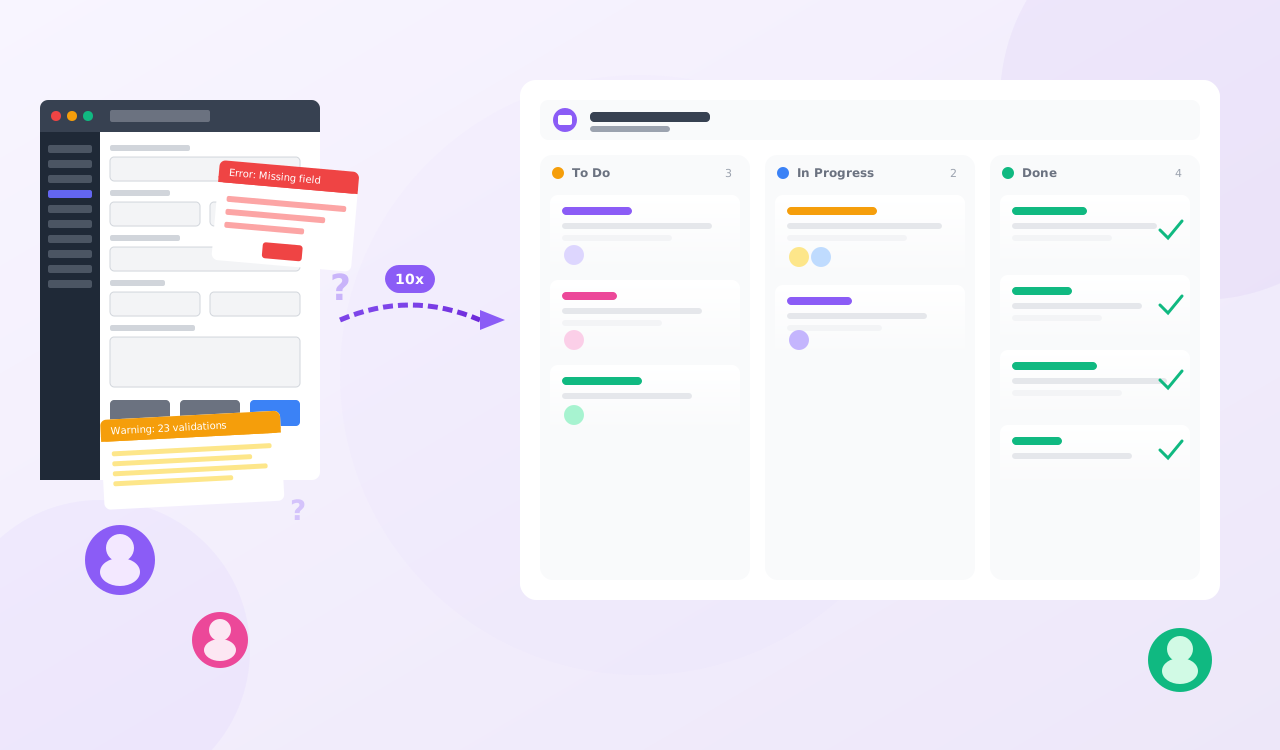
Klaro Cards was born in Belgium in 2017, first to serve industrial SMEs facing certification requirements that no tool on the market really supported. That conviction has not left us since: a company's performance is not decided in big strategic choices, it is decided in hundreds of small daily frictions that nobody measures.
We are not selling one more ERP, nor a generic no-code tool. We are building an operational hub: a single place where your business rules, your reference data and the real state of your files live, configured by your own teams, without consultants or developers.
We did not set out to build a project management tool. We set out to give small companies the operational backbone that only large enterprises used to afford — without the consultants, the complexity, or the twelve-month rollout.
An email left unanswered. A spreadsheet brought up to date the day before an audit. A piece of information you have to ask the same person for three times.
Taken one by one, each of these is negligible. That is exactly what makes them costly: none of them justifies tackling it head on, and yet their accumulation shapes the real performance of your organisation. It appears on no accounting line, which does not mean it costs nothing.
No organisation is born disorganised. It becomes so, one tool at a time, one exception at a time, one hire at a time.
Growth does not create friction. It makes it visible.
Read our white paper
Olivier uses Klaro Cards to organize executive committee meetings, track feature requests, and manage the training portfolio.

Marie uses Klaro Cards to organize the software development team and to facilitate communication among team members.

Magali uses Klaro Cards to track equipment validation in the highly regulated pharmaceutical industry.
The information exists, but everyone structures it their own way.
The data is structured, but rarely the operational day-to-day.
You have gained a tool. Not necessarily a process.
AI cannot make up for badly structured information.
One more tool adds a place to look for information. A hub removes one.
Klaro Cards connects to your business tools and your AI agents over MCP and API. Part of the work automates itself, the rest stays configurable to your own rules.
Written in business language, readable and editable without a developer ticket.
Every piece of information has a single home. Other tools read it, they never hold a copy.
Existing tools plug in rather than add up. The ERP stays the ERP.
The real state of the organisation is read off a screen, rather than reconstructed over three weeks.
The companies that will get the most value out of AI will not be the ones with the most AI. They will be the ones with the least operational friction.
Excel, WhatsApp and a paper inspection to track production.
A shared process, real-time visibility on non-conformities.
3 different mailboxes receiving requests from the outlets.
1 shared workflow, 0 requests lost between two people.
A client file passing through several hands, with no central tracking.
A status everyone can see, with no chasing to find out where it stands.
Friction is not the same in every company.
Risk assessment, maintenance, non-conformities, certifications: compliance without the last-minute scramble.
See the sector pageRoads, public buildings, contractors: keeping an overview of dozens of files running in parallel.
See the sector pageProperty management, facility management, agencies: running client files and contractors without piling up tools.
See the sector pageDue diligence, professional practices, or any line of work that does not fit a box yet. We build the brick with you.
See the sector page